

The fencing parry positions, explained


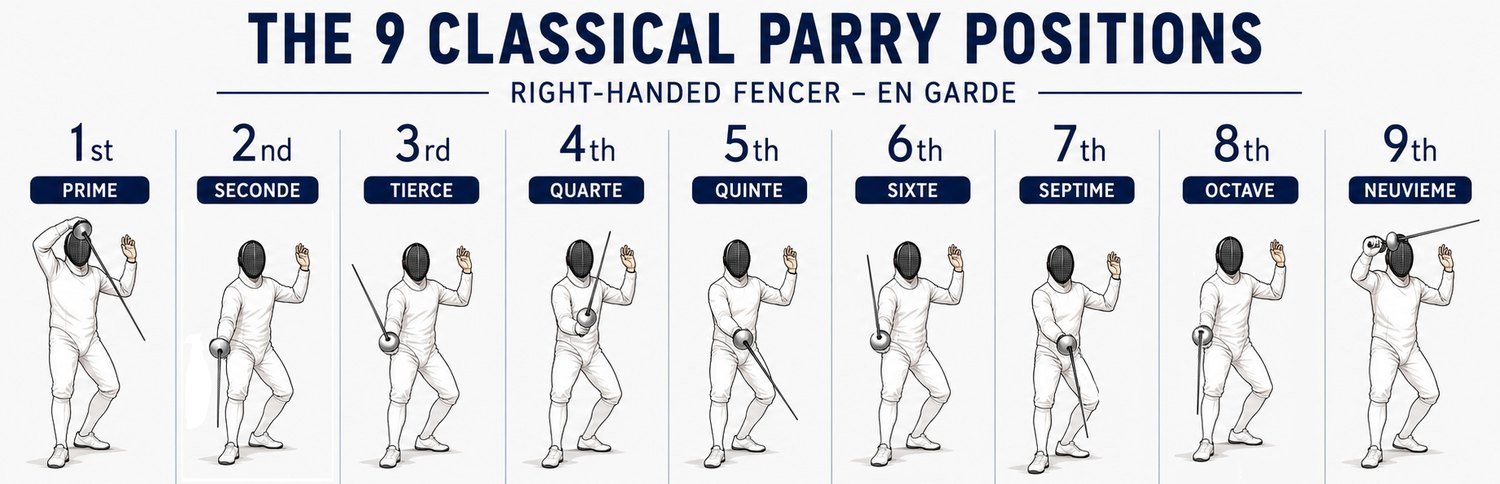
A parry is a defensive action that deflects your opponent's blade away from your target, ideally setting up your own answer (the riposte). Fencers number the parries in the old French system, prime, seconde, tierce and on through octave and neuvieme. Classical fencing counts nine positions, and modern sport fencing leans on a handful. You do not need all of them on day one, but knowing the map helps everything click.
How the lines work
Your target splits into four zones: high and low, and inside and outside (inside is the side of your sword-arm's chest, outside is away from it). Each parry closes one of those lines by moving your blade to block it. In foil and epee, right-handed fencers lean on four of them most:
- Quarte (4) protects the high inside line.
- Sixte (6) protects the high outside line.
- Septime (7) protects the low inside line.
- Octave (8) protects the low outside line.
The others (prime, seconde, tierce, quinte and neuvieme) fill in the rest and show up more in sabre and classical technique. Everything mirrors for left-handers, and sabre uses some positions differently (quinte guards the head). Because the exact hand and blade position for each number varies a little by weapon and coaching tradition, treat the numbers as a shared vocabulary and learn the precise shapes from your coach.
What makes a parry work
- Small and firm. Deflect with a short, strong wrist movement, not a big sweep. Less motion means a faster riposte.
- Keep your point toward the target so your answer is ready the instant you catch the blade.
- Stay balanced and ready to counterattack. A parry is only half the job.
- Defense creates offense. The parry-riposte, catch the blade then hit back, is the most reliable way to score in foil and sabre, where it also earns you right-of-way.
Parries are the defense. The lunge is the attack. Put them together with a coach: find a fencing club near you.
← All guides · Find a club · Club map · FAQ