

The fencing lunge, done right

The lunge is fencing's signature attack: an explosive step that carries your point to the target while your back foot stays planted. Done well it looks effortless and reaches surprisingly far. Done badly it leaves you off balance and open. Here is what a clean lunge looks like, phase by phase.
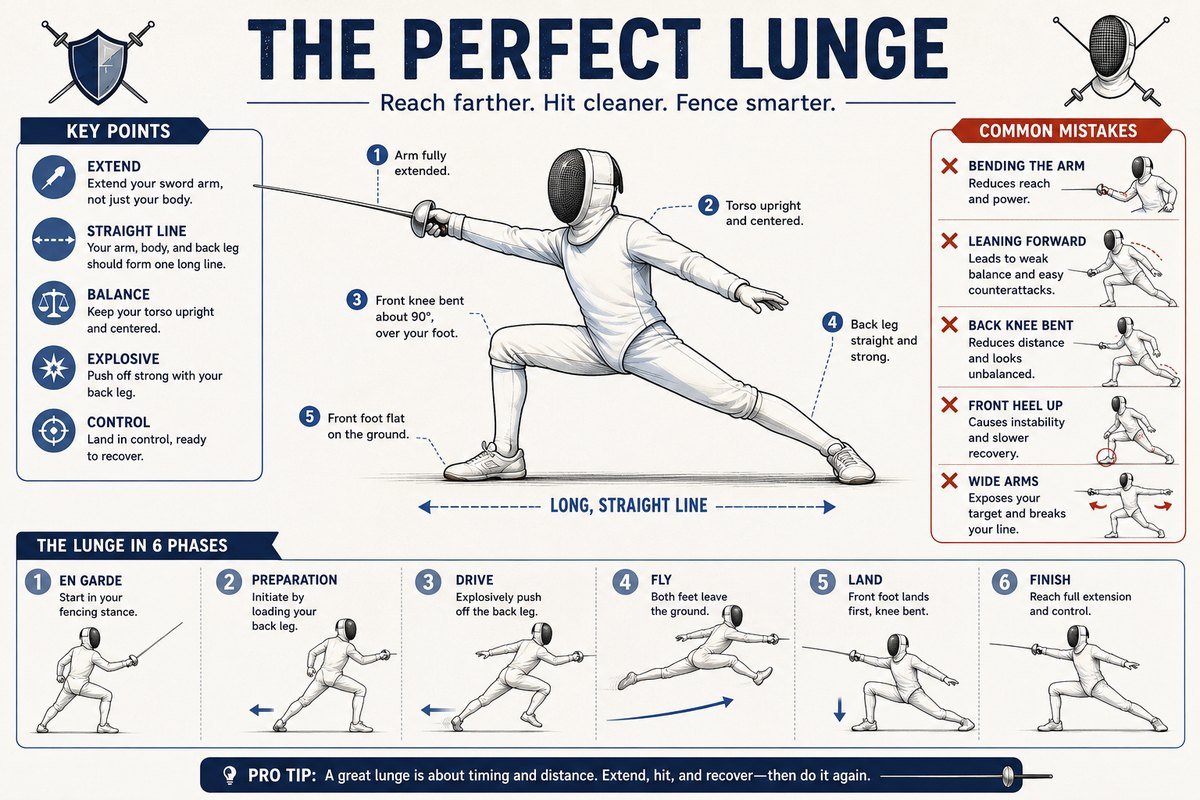
The five key points
- Extend first. Your sword arm goes out before your legs move. The point threatens the target, then the legs carry it there. Leading with the body instead of the arm is the most common beginner error.
- One straight line. Your extended arm, torso and back leg should form a single long line at full stretch.
- Balance. Keep your torso upright and centered, not tipped forward over the front knee.
- Explosive. The distance comes from pushing hard off the back leg, not from reaching with the front foot.
- Control. Land ready to recover instantly, because a lunge you cannot pull back from is a lunge that gets you hit on the return.
The lunge in six phases
- En garde: start in your fencing stance, balanced and ready.
- Preparation: load the back leg, arm beginning to extend.
- Drive: explosively push off the back leg.
- Fly: the front foot skims forward just above the floor.
- Land: the front foot lands heel-first, knee bending to about 90 degrees over the foot.
- Finish: full extension, then recover back to en garde under control.
Common mistakes
- Bending the sword arm costs reach and power.
- Leaning forward wrecks your balance and invites a counterattack.
- A bent back leg shortens the lunge and looks unbalanced.
- Front heel lifting makes you unstable and slow to recover.
- Wide arms open your target and break your line.
Drill it: practice slow, correct lunges against a wall target or in front of a mirror, checking the
long straight line each time, then add speed. More at-home work is in our
fencing drills guide.
The lunge is the attack. The parry positions are the defense, and right-of-way decides who scores when both land. New to it all? Find a club and learn it properly on the strip.
← All guides · Find a club · Club map · FAQ