

The en garde position: fencing's foundation

Every attack, defense and step in fencing starts and ends in en garde, the on-guard position. Get it right and everything else is easier: you are balanced, coiled and ready to move in any direction. Get it wrong and you are slow, off balance and easy to hit. Here is the whole stance, head to toe.
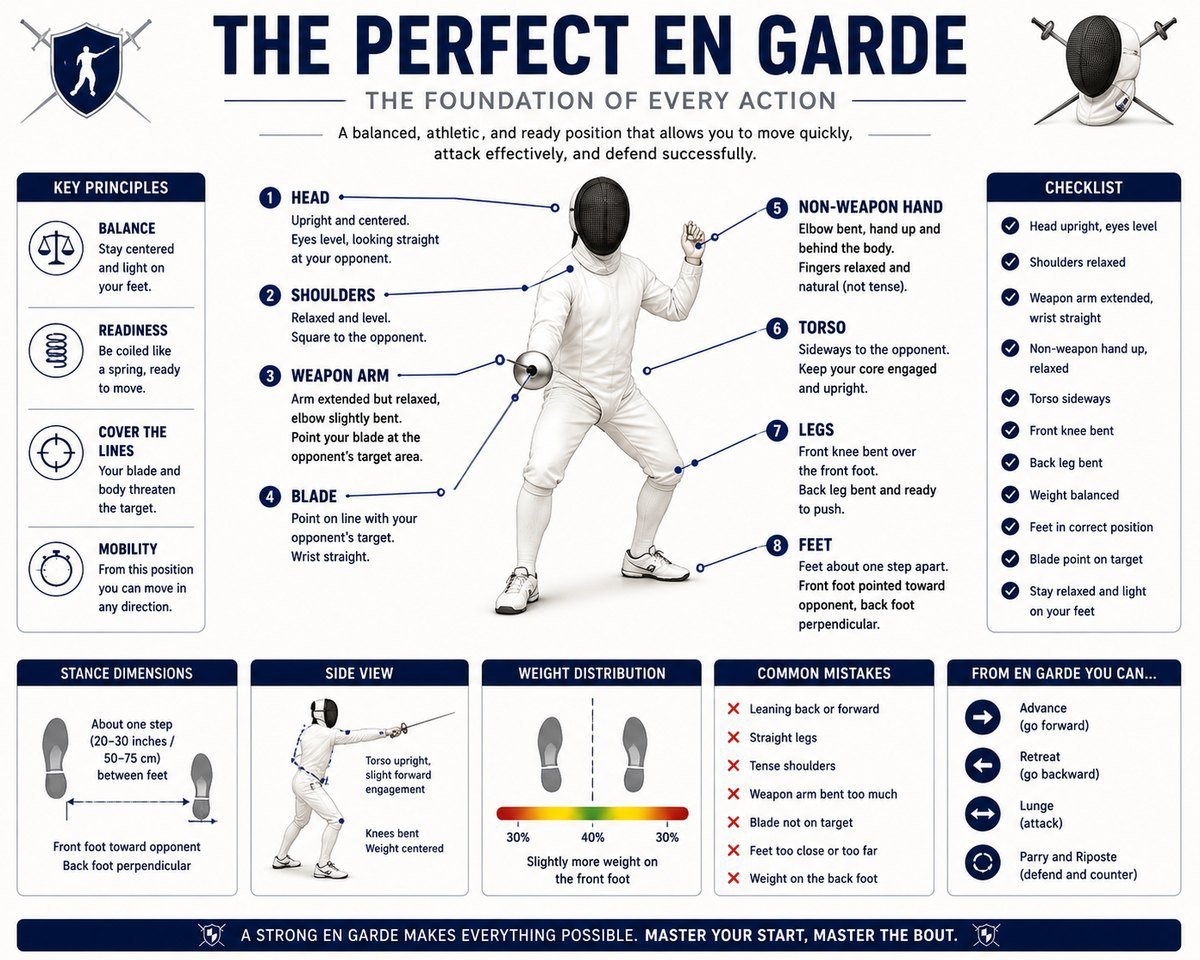
Head to toe
- Head: upright and centered, eyes level, looking at your opponent.
- Shoulders: relaxed and level, square to your opponent.
- Weapon arm: extended but relaxed, elbow slightly bent, point threatening the target.
- Blade: on line with your opponent's target, wrist straight.
- Non-weapon hand: up and behind the body, fingers relaxed, which helps your balance.
- Torso: turned sideways to the opponent (a smaller target), core engaged and upright.
- Legs: front knee bent over the front foot, back leg bent and ready to push.
- Feet: about one step apart, front foot pointing at your opponent, back foot perpendicular, forming an L.
Stance size and balance
Set your feet about one step apart, roughly 20 to 30 inches (50 to 75 cm), and keep your weight centered and light so you can push off either leg. Think of it as balanced and coiled, like a spring ready to release. Too narrow and you cannot move powerfully, too wide and you cannot move quickly.
Common mistakes
- Leaning back or forward instead of staying centered.
- Straight legs, which kill your push and your speed.
- Tense, hunched shoulders.
- Bending the weapon arm too much, or letting the blade drift off target.
- Feet too close, too far apart, or the back foot pointing the wrong way.
Everything grows from here
From a good en garde you can do all of it: advance and retreat to control distance, explode into a lunge to attack, or parry and riposte to defend and hit back. A strong start makes every action possible.
New to fencing? Start with the basics, then learn this at a club near you, where a coach will fine-tune your stance in your first lesson.
← All guides · Find a club · Club map · FAQ