
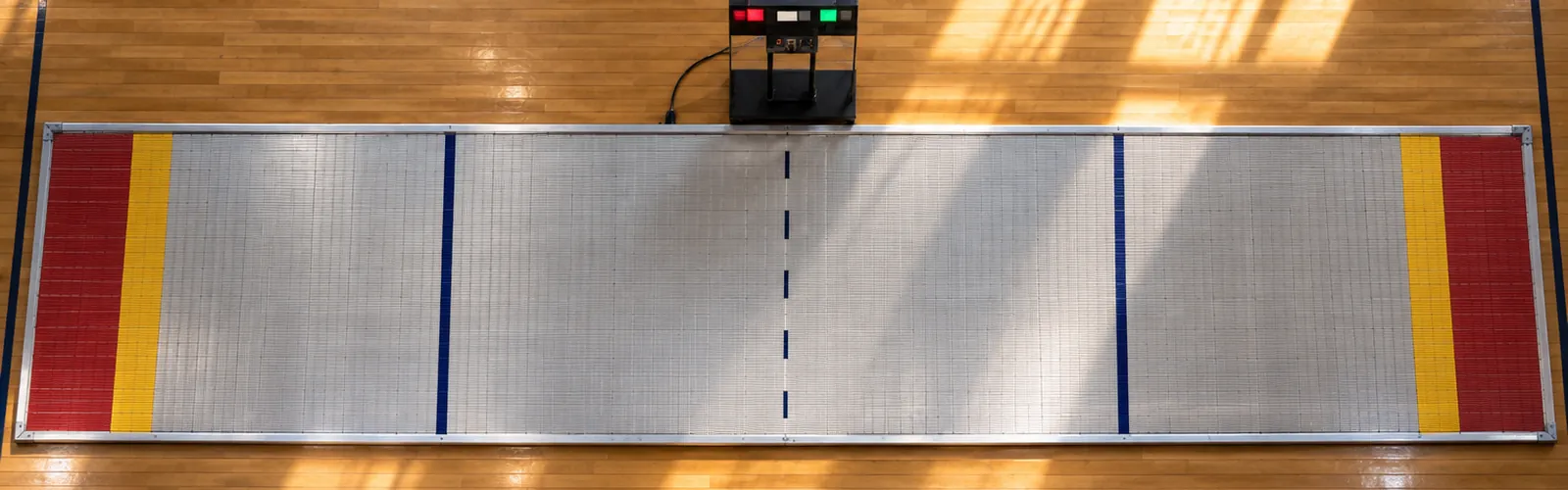
Fencing Strip Dimensions: Length, Width and Markings in Feet and Meters
A regulation fencing strip is 14 meters long (about 45 ft 11 in) and 1.5 meters wide (about 4 ft 11 in). Older rulebooks allowed up to 2 m (about 6 ft 7 in), and the official diagrams still show "1.5 to 2 m," so you will see both. Each end adds a run-off of 1.5 to 2 m, making a full competition strip 17 to 18 meters long (roughly 56 to 59 feet). Five lines are marked: a center line, two en garde lines 2 m either side of it, and two end lines 7 m from the center, with the last 2 m before each end line in a different color. The diagram above shows the layout; below, each part in meters and feet, plus how to tape a practice strip at your club.
Fencing strip dimensions at a glance
- Length: 14 m (45 ft 11 in), with a tolerance of only 4 cm (about 1.5 in) over the whole length.
- Width: 1.5 m (4 ft 11 in); 2 m (6 ft 7 in) strips are still common.
- Run-off at each end: 1.5 to 2 m (4 ft 11 in to 6 ft 7 in) beyond each end line.
- Total length with run-offs: 17 to 18 m (about 55 ft 9 in to 59 ft 1 in).
- Center line to each en garde line: 2 m (6 ft 7 in), so the two en garde lines are 4 m (13 ft 1 in) apart.
- Center line to each end line: 7 m (23 ft).
- Rear warning zone: the last 2 m (6 ft 7 in) in front of each end line.
- Space behind each fencer at the start: 5 m (16 ft 5 in) from the en garde line to the end line.
Foil, épée and sabre all use the same strip and the same markings.
The markings, from the middle out
All five lines run across the full width of the piste at right angles to its length.
- Center line. Drawn as a broken (dashed) line exactly halfway along the strip.
- Two en garde lines, 2 m on each side of the center line. The rulebook calls them on-guard lines. At the start of each bout, after every valid touch, and at the start of each period, the referee puts both fencers here with the front foot just behind the line and both fencers centered across the width. The 4 m space between the two lines is what coaches call "the box."
- The 3 m stretch between each en garde line and the start of the warning zone has no special marking and no rule attached to it.
- Rear warning zone, the last 2 m before each end line. The rules ask for it to be clearly distinguished, if possible by a different color of strip, so a retreating fencer knows how much room is left without looking down.
- Two end lines (rear limits), 7 m from the center line. Crossing one with both feet costs a touch.
So each half reads: 2 m to the en garde line, 3 m of open strip, 2 m of warning zone, then the end line. That is 7 m per half, 14 m total. New to the terms? The fencing glossary covers them.
What happens at the side lines and the end lines
The two long edges are the side lines, or lateral boundaries. If a fencer steps completely off the side with one or both feet, the referee calls "Halt." As a penalty, that fencer is moved back 1 m (about 3 ft 3 in) from where they left, or, if they went off during an attack, 1 m behind where the attack started. A touch made by a fencer who went off with only one foot still counts if the action started before the halt. If the 1 m penalty puts a fencer behind their end line, they are counted as touched, and going off with both feet to avoid being hit is penalized. Getting knocked off by accident carries no penalty.
The end lines work differently: crossing one completely, with both feet, gives the opponent a touch. That rule is covered in detail in our answer on stepping off the back of the strip. One related detail: after a halt with no touch, fencers go back where they were, and a fencer who was in front of their end line cannot be placed behind it when distance is reset. For how bouts are scored overall, see fencing rules and scoring.
Metallic strips: why épée needs a grounded strip
At tournaments you will often fence on a conductive strip: a mat of metal, metal mesh or another conductive material, connected to ground. The rules say it must cover the whole length and width of the strip including the run-offs, its resistance from one end to the other must not exceed 5 ohms, and it should be grounded at the center. Even the paint used for the lines must stay conductive, so a hit landing exactly on a line is neutralized too. The goal: a point that hits the floor should not light the box.
- Épée is the weapon that needs this most. An épée tip pressed against anything, including a plain floor, lights the box like a real touch. The referee must disregard touches made on the ground where it is not insulated, but spotting them by eye is hard, which is why tournaments put épée on grounded strips whenever they can.
- Foil has a different problem. On an ordinary floor, a foil tip hitting the floor shows an off-target (white) light, which stops the action. On a grounded strip the scoring machine ignores it and the bout continues.
- Sabre is the least affected, because a sabre touch only registers when the blade contacts the opponent's lamé.
In foil and épée you may not drag your point along an electric strip during the bout, and in all three weapons you may not press your blade against the strip to straighten it. Both draw a yellow card. For how the cords connect to the strip, see why fencers are attached to cords.
USA Fencing sets minimums for this at sanctioned tournaments. Its regional tournament requirements ask for at least four grounded strips, 2 m (6.5 ft) of empty safety space at each end of every strip, and at least 1.4 m (4.5 ft) of room for the referee beside each strip. The full rulebook is on the USA Fencing rules page.
The finals strip on a podium
Semifinals and finals at big events are often fenced on a raised platform. The rules cap its height at 50 cm (about 20 in), require it to be at least 25 cm (about 10 in) wider than the strip on each side, and require a gentle slope down to the floor at each end. The conductive surface must cover the whole width of the platform. The 25 cm conductive safety borders along each side are not part of the strip, so a foot on the border is off the strip.
Piste or strip? British vs American
Same thing, two words. "Piste" is the French word, used in the international rulebook, in British fencing and across most of Europe. American fencers and the USA Fencing rulebook say "strip." You may also hear "runback" for the run-off and "the box" for the 4 m between the en garde lines. A coach who says "use the whole piste" and one who says "use the whole strip" mean exactly the same thing.
Setting up a practice strip with tape
Most clubs mark practice strips with floor tape. Here is a layout that matches competition markings, measured from one end line:
- Mark the two long side lines 1.5 m (4 ft 11 in) apart. If you have room, 2 m (6 ft 7 in) is fine for practice too.
- End line: 0 (your starting point).
- Warning line (start of the rear warning zone): 2 m, about 6 ft 6 3/4 in.
- First en garde line: 5 m, about 16 ft 4 7/8 in.
- Center line (dashed): 7 m, about 22 ft 11 5/8 in.
- Second en garde line: 9 m, about 29 ft 6 3/8 in.
- Second warning line: 12 m, about 39 ft 4 1/2 in.
- Second end line: 14 m, about 45 ft 11 1/4 in.
A few practical tips:
- Use a metric tape measure if you can. The feet figures above are rounded, and small errors add up over 14 m. Measure every line from the same end rather than from the previous line.
- Leave the run-off. Keep 1.5 to 2 m (about 5 to 6.5 ft) of clear floor beyond each end line, free of walls, benches and gear bags. A fencer retreating fast needs somewhere to go.
- Use a different color for the warning zones, or tape a cross hatch inside them, so fencers learn to feel where they are on the strip.
- Short on space? Keep the 4 m box exactly right and shorten both ends equally. It is not regulation, so tell fencers they are on a short strip.
- Épée on a plain floor means floor hits will light the box. Many clubs accept this for practice and simply ignore obvious floor touches, or lay one grounded strip for épée bouts and lessons.
- Place the scoring box beside the center line, at least 1 m (about 3 ft 3 in) from the edge of the strip, so it is visible to both fencers and no one trips on the reels.
If you are planning a whole room, our guide on how to start a fencing club covers the bigger picture, and the answer on choosing a scoring machine for a small club covers the electric side.
← All guides · Find a club · Club map · FAQ